Lena Cansdale’s “Jews on the Silk Road” is a very interesting examination of the evidence which shows Jewish activity on the Silk Road. Many examples were given, from small personal prayer letters to a burial ground with twenty tombstones and memorial tablets that were inscribed in Judeo-Persian. All this evidence collecting is fascinating to me, because this connection of Jews on the Silk Road was something I previously had taken for granted, and naturally assumed that this would have been the case. In my Mediterranean History course, the relation of Jews with Middle Eastern, Chinese and Indian people was briefly discussed in the context of Jews playing a very prominent role as the intermediary commerce role between people of the East (usually Muslims or what was described to the class as ‘Pagans’) and the Christian West. In this Mediterranean History course, I learned of the Jews mainly in the context of the Mediterranean, but knew that they travelled and were used specifically for intermediaries for commerce. Now, after reading Cansdale, I feel that I have a greater picture of how the Jews could have possibly travelled from the parts of the Roman Empire through to the Silk Road. This is noted with Jewish settlements in India as early as the 10th century, and the letter Cansdale first introduces, that describes a Jewish settlement in China. This was clearly made possible because Jews were reported as being present on the Silk Road engaged in trading over great distances... clearly, since they travelled all the way from Europe! I now have this moving dotted line (like the kind at the beginning of Casablanca or Indiana Jones) image in my head of the Jews travelling from the far west of the map of Europe, to the far east on our Silk Road map.
Monday, March 22, 2010

Monday, February 22, 2010
The Great Game
This week we returned to the course textbook and looked at chapters 10-14 in 'The Silk Road.'
Monday, February 8, 2010
Islam Today
In the first readings for tomorrow's class we returned to Edward Said's The Clash of Ignorance. He attempts to unpack Huntington's thesis and figure our exactly what is the clash that Huntington is chronicling. Said suggests that Huntington had no time to spare for internal dynamitcs and plurality of every civilization, and that he demonstrates ignorance in presuming to speak for a whole religion and treat it as a civilization instead. Afteer 9/11 especially we see that in an instant that everything 'prophesized' in Huntington's book (and other's like it) came 'true.' In came the stereotyping, the fear of terrorism and Muslims all fuelds by this ignorance that was pushed froth by the media and authors like Huntington.
In the second reading, by Mahmood and Hirschkind, we start in 1999 with the story of Mavis Leno (Jay Leno's wife) and her campaign against the Taliban's brutal treatment of Afghan women. What is interesting about this article is that is puts forth all the evidence that has been out there for years that has been conveniently ignored. As presented in Said's article, the ideas are moulded by the media in order to fit with the picture in which the American government wishes to paint of 'the other.' Mahmood and Hirschkind present the evidence that the Americans had brought in harsh military brutality as they attempted to build up the Taliban regime in hopes of building a partner in the desolate Middle East region. As a political science student I have learned this time and time again, but everytime I read studies like this it reminds me more and more of how very much the media is at work every day and in every story. More than a decade after America's first involvement with the Taliban so many people remain ignorant of the facts. Mavis Leno states that '... they forbade women from all positions of employment, eliminated schools for girls... etc.' but does not discuss the predicament of the women who were forced to deal with an entirely changed society with massive military and economic support provided by the US as part of their Cold War strategy. It is upsetting to see that the historical context has been silenced in such a way that charitable work becomes distorted and pointed against the wrong enemy.
Here is a youtube video with Edward Said discussing Huntington's 'bloating' book 'Clash of Civilization'.... it's interesting because he does NOT seem to be a fan of this book AT ALL. This is just part 1, if you're interested you can continue on to part 2/3/4.
http://www.youtube.com/watch?v=boBzrqF4vmo
In the second reading, by Mahmood and Hirschkind, we start in 1999 with the story of Mavis Leno (Jay Leno's wife) and her campaign against the Taliban's brutal treatment of Afghan women. What is interesting about this article is that is puts forth all the evidence that has been out there for years that has been conveniently ignored. As presented in Said's article, the ideas are moulded by the media in order to fit with the picture in which the American government wishes to paint of 'the other.' Mahmood and Hirschkind present the evidence that the Americans had brought in harsh military brutality as they attempted to build up the Taliban regime in hopes of building a partner in the desolate Middle East region. As a political science student I have learned this time and time again, but everytime I read studies like this it reminds me more and more of how very much the media is at work every day and in every story. More than a decade after America's first involvement with the Taliban so many people remain ignorant of the facts. Mavis Leno states that '... they forbade women from all positions of employment, eliminated schools for girls... etc.' but does not discuss the predicament of the women who were forced to deal with an entirely changed society with massive military and economic support provided by the US as part of their Cold War strategy. It is upsetting to see that the historical context has been silenced in such a way that charitable work becomes distorted and pointed against the wrong enemy.
Here is a youtube video with Edward Said discussing Huntington's 'bloating' book 'Clash of Civilization'.... it's interesting because he does NOT seem to be a fan of this book AT ALL. This is just part 1, if you're interested you can continue on to part 2/3/4.
http://www.youtube.com/watch?v=boBzrqF4vmo
Monday, February 1, 2010
From the Spread of Islam to Contemporary views of Muslim people
In this week's readings, we first encountered a general history of the spread of the Islamic faith from Ayoub, and then an examination of Islam as a part of the contemporary world by Ernst. Ayoub's article covers big historical points about the rise of Islam as well as the on going turmoil between Christian-Islam relationship. This is important because it paints a picture of the relationship that Christians had with Muslims from the outbreak of the religion's rise to power in the region. It is also useful with the Ernst article, because together we see the progressive change of attitudes between the two religious groups. In more contemporary times, as pointed out in Ernst's article, we see that what used to be Muslims vs. Christians, now becomes Islam vs. the West. Ernst brings to the light the problem with generalizing Muslims as an entire religious group targeted as the enemy of the West. I find this article to be completely provocative because he, as a nonMuslim, is trying to convince readers that Islam is human, and not a combination of the fundamentalist acts of aggression through terrorism.
An interesting fact that we learned in class about this article is that the editors found it to be 'apologetic for terrorism' even though Ernst was not in fact a Muslim himself. He told them that he is not a Muslim but just a scholar studying them, trying to make people avoid prejudice when studying Islam. The more we talked about this article in class, the more I think I will pick up the rest of this book and read it. I am very interested to know what else Ernst has to say, as he seems like a very fascinating individual who has a passion for exposing the truth and innocence about Islam.
An interesting fact that we learned in class about this article is that the editors found it to be 'apologetic for terrorism' even though Ernst was not in fact a Muslim himself. He told them that he is not a Muslim but just a scholar studying them, trying to make people avoid prejudice when studying Islam. The more we talked about this article in class, the more I think I will pick up the rest of this book and read it. I am very interested to know what else Ernst has to say, as he seems like a very fascinating individual who has a passion for exposing the truth and innocence about Islam.
Monday, January 11, 2010
Manichaeism
In his 'Gnosis on the Silk Road', author Hans-Joachim Klimkeit introduces the founder of Manichaeism [Mani: 216-276] as the only gnostic system that became a broad historical force. To tie in with the past few blogs and lectures, Manichaeism in "Central Asia came to overshadow the Syrian Church of Nestorian persuasion and to rival Buddhism". Mani's method was syncretistic, but his system was on the contrary the most monumental single embodiment of the gnostic religions principle, with doctrincal and mythological representation included elements of older religions were consciously employed."
What all this means is that Mani was inspired to borrow aspects from the religions that he grew up around (Christianity, Judaism, Buddhism, Islam and Zoroastrianism) and combine them to make a sort of hybrid, picking and choosing the elements that intrigued him the most, making it a religion completely unique to his personal beliefs.
In The Cologne Mani Codex, we find an autobiography of Mani's life. An interesting aspect of the CMC that is brought up by Ellen Bradshaw Aitkens, is that it contains a running title 'Concerning the Origins of His Body', is said to have a double meaning refering both to the story of Mani's existence and to the origin of the religious movement he founded. The CMC is mostly a set of memoirs of Mani's words and deeds.
Now that I have a simple base of what we're focusing on, I want to analyze the process that Mani took in forming this new religious philosophy. Manachaeism claims to present the complete version of the teachings that were corrupted by followers of its predecessors in the other religions. Mani attempt at syncretism is clearly his own personal attempt to reconcile the disparate or contrary beliefs of the religions around him. While Jonas beliefs that 'the heart of Manichaeism was Mani's own speculative version of the gnostic myth of cosmic exile and salvation,' the fact that Mani's teaching were developed further after his death and elaborated and applied in various ways demonstrates to me a tendency towards personal preference. What I mean is that while Mani went about melding in practices of various religious schools of thought to form what HE believed to be the perfected religion, his followers were witness to this attempt and continued the tradition of searching for perfection after his death. Even if the various elaborations were mostly unified, it still shows that by teaching his followers that his religion was searching to perfect the errors of the past, they too wanted to search for perfection. This forced the religion into an everchanging system that was always evolving. Whether this was a good or bad thing is up for debate, but it could have very well led to the slow demise of the religion.
What all this means is that Mani was inspired to borrow aspects from the religions that he grew up around (Christianity, Judaism, Buddhism, Islam and Zoroastrianism) and combine them to make a sort of hybrid, picking and choosing the elements that intrigued him the most, making it a religion completely unique to his personal beliefs.
In The Cologne Mani Codex, we find an autobiography of Mani's life. An interesting aspect of the CMC that is brought up by Ellen Bradshaw Aitkens, is that it contains a running title 'Concerning the Origins of His Body', is said to have a double meaning refering both to the story of Mani's existence and to the origin of the religious movement he founded. The CMC is mostly a set of memoirs of Mani's words and deeds.
Now that I have a simple base of what we're focusing on, I want to analyze the process that Mani took in forming this new religious philosophy. Manachaeism claims to present the complete version of the teachings that were corrupted by followers of its predecessors in the other religions. Mani attempt at syncretism is clearly his own personal attempt to reconcile the disparate or contrary beliefs of the religions around him. While Jonas beliefs that 'the heart of Manichaeism was Mani's own speculative version of the gnostic myth of cosmic exile and salvation,' the fact that Mani's teaching were developed further after his death and elaborated and applied in various ways demonstrates to me a tendency towards personal preference. What I mean is that while Mani went about melding in practices of various religious schools of thought to form what HE believed to be the perfected religion, his followers were witness to this attempt and continued the tradition of searching for perfection after his death. Even if the various elaborations were mostly unified, it still shows that by teaching his followers that his religion was searching to perfect the errors of the past, they too wanted to search for perfection. This forced the religion into an everchanging system that was always evolving. Whether this was a good or bad thing is up for debate, but it could have very well led to the slow demise of the religion.
Nestorian Christianity
The relationship between Nestorian Christianity and Chinese culture through the 6th century is fascinating. We discussed how the Nestorian Christians came to be in their divergent beliefs from the Roman Catholics, and how they were forced to move. Their move took them to China where they were able to flourish because they were tolerated by Chinese society. In the articles of the week, this influence is evident as being reciprocal as they played off of each other. What is interesting is that the main historical sources of Nestorian Christianity survived in the Dunhuang manuscripts instead of where the religion was originally started - in Europe. This religion was able to flourish because they were far away from the opposing Christians in Europe. This enabled them to develop in China completely independently with many methods and teachings adopting Buddhist terminology and iconography. They did this as a way of reaching out to the Chinese and explaining their religion in a way the Chinese could grasp.
As much as we are not supposed to use Wikipedia as anything but a source to quickly browse, I found it interesting that when I googled 'NESTORIAN CHRISTIANITY' this link came up:
http://en.wikipedia.org/wiki/Assyrian_Church_of_the_East_in_China
This provides evidence of the enormous impact of the Eastern Chinese culture on Nestorian (or Assyrian) Christianity.
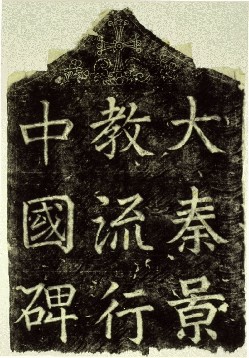
In this picture of the top portion of the Nestorian Stele, ["STELE (RECORDING) THE SPREAD OF THE RELIGION OF LIGHT (CHRISTIANITY) FROM ROMSE TO CHINA] we can see that it is written in Chinese characters.
As much as we are not supposed to use Wikipedia as anything but a source to quickly browse, I found it interesting that when I googled 'NESTORIAN CHRISTIANITY' this link came up:
http://en.wikipedia.org/wiki/Assyrian_Church_of_the_East_in_China
This provides evidence of the enormous impact of the Eastern Chinese culture on Nestorian (or Assyrian) Christianity.
In this picture of the top portion of the Nestorian Stele, ["STELE (RECORDING) THE SPREAD OF THE RELIGION OF LIGHT (CHRISTIANITY) FROM ROMSE TO CHINA] we can see that it is written in Chinese characters.
Also, the influence of the Chinese on Nestorian Christianity is evident with the different forms that the Cross took. We can see that Buddhist iconography and Chinese characters became part of the new form of cross on the following website, which shows a variety of shapes and sizes that the cross took in this eastern form of Christianity.
Monday, November 23, 2009
Dunhuang
From the extensive readings on Dunhuang in the Course Reader and the textbook, we have been asked to determine:
what is the socio-political situation at the site, and how does Buddhism figure in? What do we know, and what do we not know, that might help us reconstruct the actual practice of Buddhism in the Dunhuang region?
So firstly, what is the socio-political situation at Dunhuang?
Dunhuang was a large oasis settlement supporting a considerable population and many temples to various faiths. Cotton fields flourished and sheep and goats grazed on the extensive pastures (chapter 7, pg 88). This goes to show, that Dunhuang was a prominent oases town that had much to offer in terms of economic capabilities. In geo-political terms, the fact that Dunhuang was at the eastern most point of the Silk Road, made it a key place travellers and explorers aimed to reach. If it were not for the Silk Road path, Buddhism may not have taken hold in China to the extent that it did.
How does Buddhism figure in?
As we know from reading about Abott Wang, Dunhuang was home to the Caves of the Thousand Buddhas, making it the most important desert oases. This cave site came to be because there were large monk population in Dunhuang, and beginning in the fourth century AD, the caves were hollwed out in cliffs and eventually filled with clay sculptures of Buddhist deities, and with wall-paintings influenced by earlier Buddhist sites such as Bamiyan and Gandhara. Buddhism was brought to China along the Silk road, and was enthusiatically adopted and flourished for many centuries.
What might help us reconstruct the actual practices of Buddhism in the Dunhuang region?
The documents that were found in the caves point to those who would have been in Dunhuang and the religions and beliefs that they each held. Not only were there documents on religious texts, there were also such things as lease agreements. The manuscripts and governing documents clearly reconstruct not only the religious practices of the region, but the every day activities as well.
what is the socio-political situation at the site, and how does Buddhism figure in? What do we know, and what do we not know, that might help us reconstruct the actual practice of Buddhism in the Dunhuang region?
So firstly, what is the socio-political situation at Dunhuang?
Dunhuang was a large oasis settlement supporting a considerable population and many temples to various faiths. Cotton fields flourished and sheep and goats grazed on the extensive pastures (chapter 7, pg 88). This goes to show, that Dunhuang was a prominent oases town that had much to offer in terms of economic capabilities. In geo-political terms, the fact that Dunhuang was at the eastern most point of the Silk Road, made it a key place travellers and explorers aimed to reach. If it were not for the Silk Road path, Buddhism may not have taken hold in China to the extent that it did.
How does Buddhism figure in?
As we know from reading about Abott Wang, Dunhuang was home to the Caves of the Thousand Buddhas, making it the most important desert oases. This cave site came to be because there were large monk population in Dunhuang, and beginning in the fourth century AD, the caves were hollwed out in cliffs and eventually filled with clay sculptures of Buddhist deities, and with wall-paintings influenced by earlier Buddhist sites such as Bamiyan and Gandhara. Buddhism was brought to China along the Silk road, and was enthusiatically adopted and flourished for many centuries.
What might help us reconstruct the actual practices of Buddhism in the Dunhuang region?
The documents that were found in the caves point to those who would have been in Dunhuang and the religions and beliefs that they each held. Not only were there documents on religious texts, there were also such things as lease agreements. The manuscripts and governing documents clearly reconstruct not only the religious practices of the region, but the every day activities as well.
Subscribe to:
Posts (Atom)