In his 'Gnosis on the Silk Road', author Hans-Joachim Klimkeit introduces the founder of Manichaeism [Mani: 216-276] as the only gnostic system that became a broad historical force. To tie in with the past few blogs and lectures, Manichaeism in "Central Asia came to overshadow the Syrian Church of Nestorian persuasion and to rival Buddhism". Mani's method was syncretistic, but his system was on the contrary the most monumental single embodiment of the gnostic religions principle, with doctrincal and mythological representation included elements of older religions were consciously employed."
What all this means is that Mani was inspired to borrow aspects from the religions that he grew up around (Christianity, Judaism, Buddhism, Islam and Zoroastrianism) and combine them to make a sort of hybrid, picking and choosing the elements that intrigued him the most, making it a religion completely unique to his personal beliefs.
In The Cologne Mani Codex, we find an autobiography of Mani's life. An interesting aspect of the CMC that is brought up by Ellen Bradshaw Aitkens, is that it contains a running title 'Concerning the Origins of His Body', is said to have a double meaning refering both to the story of Mani's existence and to the origin of the religious movement he founded. The CMC is mostly a set of memoirs of Mani's words and deeds.
Now that I have a simple base of what we're focusing on, I want to analyze the process that Mani took in forming this new religious philosophy. Manachaeism claims to present the complete version of the teachings that were corrupted by followers of its predecessors in the other religions. Mani attempt at syncretism is clearly his own personal attempt to reconcile the disparate or contrary beliefs of the religions around him. While Jonas beliefs that 'the heart of Manichaeism was Mani's own speculative version of the gnostic myth of cosmic exile and salvation,' the fact that Mani's teaching were developed further after his death and elaborated and applied in various ways demonstrates to me a tendency towards personal preference. What I mean is that while Mani went about melding in practices of various religious schools of thought to form what HE believed to be the perfected religion, his followers were witness to this attempt and continued the tradition of searching for perfection after his death. Even if the various elaborations were mostly unified, it still shows that by teaching his followers that his religion was searching to perfect the errors of the past, they too wanted to search for perfection. This forced the religion into an everchanging system that was always evolving. Whether this was a good or bad thing is up for debate, but it could have very well led to the slow demise of the religion.
Monday, January 11, 2010

Nestorian Christianity
The relationship between Nestorian Christianity and Chinese culture through the 6th century is fascinating. We discussed how the Nestorian Christians came to be in their divergent beliefs from the Roman Catholics, and how they were forced to move. Their move took them to China where they were able to flourish because they were tolerated by Chinese society. In the articles of the week, this influence is evident as being reciprocal as they played off of each other. What is interesting is that the main historical sources of Nestorian Christianity survived in the Dunhuang manuscripts instead of where the religion was originally started - in Europe. This religion was able to flourish because they were far away from the opposing Christians in Europe. This enabled them to develop in China completely independently with many methods and teachings adopting Buddhist terminology and iconography. They did this as a way of reaching out to the Chinese and explaining their religion in a way the Chinese could grasp.
As much as we are not supposed to use Wikipedia as anything but a source to quickly browse, I found it interesting that when I googled 'NESTORIAN CHRISTIANITY' this link came up:
http://en.wikipedia.org/wiki/Assyrian_Church_of_the_East_in_China
This provides evidence of the enormous impact of the Eastern Chinese culture on Nestorian (or Assyrian) Christianity.
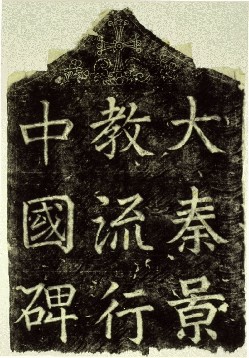
In this picture of the top portion of the Nestorian Stele, ["STELE (RECORDING) THE SPREAD OF THE RELIGION OF LIGHT (CHRISTIANITY) FROM ROMSE TO CHINA] we can see that it is written in Chinese characters.
As much as we are not supposed to use Wikipedia as anything but a source to quickly browse, I found it interesting that when I googled 'NESTORIAN CHRISTIANITY' this link came up:
http://en.wikipedia.org/wiki/Assyrian_Church_of_the_East_in_China
This provides evidence of the enormous impact of the Eastern Chinese culture on Nestorian (or Assyrian) Christianity.
In this picture of the top portion of the Nestorian Stele, ["STELE (RECORDING) THE SPREAD OF THE RELIGION OF LIGHT (CHRISTIANITY) FROM ROMSE TO CHINA] we can see that it is written in Chinese characters.
Also, the influence of the Chinese on Nestorian Christianity is evident with the different forms that the Cross took. We can see that Buddhist iconography and Chinese characters became part of the new form of cross on the following website, which shows a variety of shapes and sizes that the cross took in this eastern form of Christianity.
Subscribe to:
Posts (Atom)